dunaflat Budapest apartments rent accommodation for holidays in Budapest. City centre sightseen. City guide for your holidays in Budapest with Dunaflat. budapest
apartments rental Budapest
 
 
Budapest apartments (HOME) | reservation | location | guest book feedback


Budapest architectonic

Capitale architettonica


The Castle of Buda
The first citizens of Buda moved to the hills in the middle of the 13th century, after an unexpected, devastating attack by the Mongols. Later the royal court was relocated to the Southern end of the mountain that is when the quarter began to boom. Buda became one of the most significant cities of Europe by the 14th century, the population was around 8000. It slowly declined during the Turkish rule, which started in 1541, and little remained of it after the liberating siege (1686) with 75 days of cannon fire. The Austrian authorities could count but 300 inhabitants in the city. It was later rebuilt, and the street lines were not changed, but most two-storey buildings had only one storey from then on. They built a Baroque town, hiding the ruins behind thick walls. It was under siege again in 1849, then rebuilt again to host Hungarian ministries. After a long and peaceful period, it was reduced to ruins again in January 1945. Several Medieval remnants were uncovered during cleaning up the ruins, and these remnants were not walled up again. Based on the traces, the walls must have been coloured everywhere.

Fisherman's Bastion in Budapest

Jewish Budapest
The success of modern Budapest was significantly due to the diligence and organizational skills of Jewish industrialists. There are still many memories of the period. The Jewish Museum reminds of the religious traditions, while the Holocaust Centre, which was opened in 2004, reminds of the terror. After 1990, a real Jewish cultural Renaissance began in Budapest. The city has the most populous active Jewish community in Central Europe, who cherish their religious, artistic and historical heritage. There is a much larger population of Budapest inhabitants with Jewish origin, who consider themselves Hungarian and do not practice their religion, but are interested in the history of their ancestors.

Turkish past in Budapest
Buda and Pest lived under Turkish rule for nearly 150 years between 1541 and 1686, but you can hardly see any remnants of it. The reason is that the 29 djamis, 52 mosques and tombs that had been built in the two cities were all destroyed after the Christian reconquest. However, the Medieval churches of Pest and Buda remained because the Turks preserved them (by turning them into djamis). The first floating bridge between Pest and Buda was also constructed in the Turkish era. It consisted of 70 elements altogether, the central four elements could be lifted to allow for ships to pass through.

Art Nouveau
Budapest was essentially built in the third part of the 19th century and the early 20th century with a tempo that can be compared to the construction of Chicago. The end of this peaceful period, which lasted until 1914, was characterized by the Art Nouveau style in architecture. This imported style had a Hungarian master, who was acclaimed in Europe as well: Odon Lechner (1845-1914), the Hungarian Gaudí. The nickname only applies in the sense that Lechner's works are also easy to recognize but they do not resemble the pieces of the Catalan master in any way. He dressed up modern functionalism with his characteristic decorative forms, using Eastern, especially Indian motives. His disciples once aske him why he designed the roof of one of his buildings (the Postal Savings Bank) to be so decorative, when people cannot even see it from the street. His famous, witty response was: Birds can see it, though… The memories of Art Nouveau mostly lie in two areas of Budapest: in Lipótváros (to the north of the Inner City), and City Park. However, several other buildings of this style are scattered in Budapest.

Thermal Bath in Budapest

Bauhaus
In the golden era of the development of Budapest, i.e. between 1870 and 1914, tradition and innovation complemented each other rather well. However, World War I and the subsequent Versailles Peace Treaty, which had a disastrous impact on Hungary, changed the social climate for the worse. People blamed the too rapid changes, and the too much social and artistic innovation for the problems. Therefore, modern trends were sidelined for over a decade only to emerge with even greater force afterwards, especially by the followers of the work of the German Bauhaus style. This style made its mark on nearly all districts of Budapest, on the Pest and the Buda side alike. It was clearly a dominant tendency in the city between 1930 and 1948: large residential buildings, cinemas, churches and even an airport was built in this style. In spite of the Bauhaus dominance, the Neo-neo-Baroque style, which was the favourite of the ruling elite between the two wars, also prevailed.

Gothic and Neogothic Budapest
Buda Castle was an important royal court of Europe in the 14th and 15th centuries, with significant income and construction projects. Several Hungarian kings were great admirers and supporters of art. Unfortunately, the Gothic royal palace fell victim to the liberating siege of 1686, when the united European Christian army liberated Buda from the Turkish rule. In the civic section of the Castle, there was only one, two-storey residential building that could be reconstructed. The Matthias Church, which seems to be a Gothic masterpiece, is in fact an interesting and creative, imaginative reconstruction, which far exceeds the qualities and dimensions of the original church. Gothic style, however, arrived in Budapest again in the second half of the 19th century it was considered by many as the only eternal style. The architects' competition for the Parliament was also won by a Neo-Gothic plan, and churches were even built in the 20th century in Neogothic style.

Royal Palace in Budapest

The classicist Budapest
The Classicist style dominated the first four decades of the 19th century, not it Budapest (it did not exist as such at that time) but in Pest. It was a very dynamic era of Hungarian history: people were fighting for the survival of the Hungarian language (it was almost wiped out by German), which entailed the intensification of national sentiment. It was a golden age for parties, social gatherings, literary saloons. Classicism used to dominate the landscape of Pest. It was later overshadowed by the construction boom of the third part of the century.

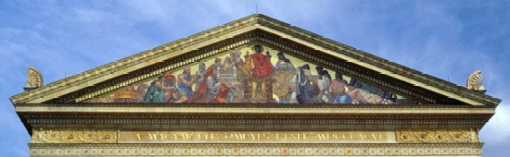
Budapest Museum of Fine Arts

The Roman Remnants
Budapest is a very ancient and young city at the same time. In the Roman era, the River Danube was the Eastern border of the empire for several hundreds of years. The name of the significant town lying in the current area of Óbuda was Aquincum, which means rich water in the Eravisc language of Celtic origin. This town was the centre of Eastern Pannonia province between 10 B.C. and 409 A.D. At the beginning, 6000 soldiers were garrisoned here, and the total population of the two (military and civilian) towns grew to around 40 thousand by the 3rd century. Aquincum was raised to the rank of colonia by Emperor Septimus Severus in 194 A.D. The well-organized towns had 3-11 meter wide streets, and they built more and more private baths and heated villas, in addition to the military and civilian baths. The town had two open-air theatres, i.e. amphitheatres, which was quite a rare thing. After the influx of the Hungarians, the Roman ruins were used for constructions, or they built on top of them. The Roman ancestors were forgotten. The first remnants were only uncovered in the 1770s. Several sites, including a 106 x 90 meter viceroy's palace had to be buried again after its discovery and detailed documentation, because it could not be presented and maintained.

Il liberty
Budapest è stata costruita in sostanza nell'ultimo terzo dell'Ottocento e all'inizio del Novencento a ritmi americani. Lo stile dominante nell'archittetura di questa epoca di pace fino al 1914 era lo stile di liberty. Questo stile, aveva un gran maestro ungherese riconosciuto anche in Europa nella persona di Odon Lechner (1845/1914), il Gaudí ungherese . I ricordi dello stile liberty si concentrano a Budapest in due zone, nella Lipótváros e nel Parco comunale.